
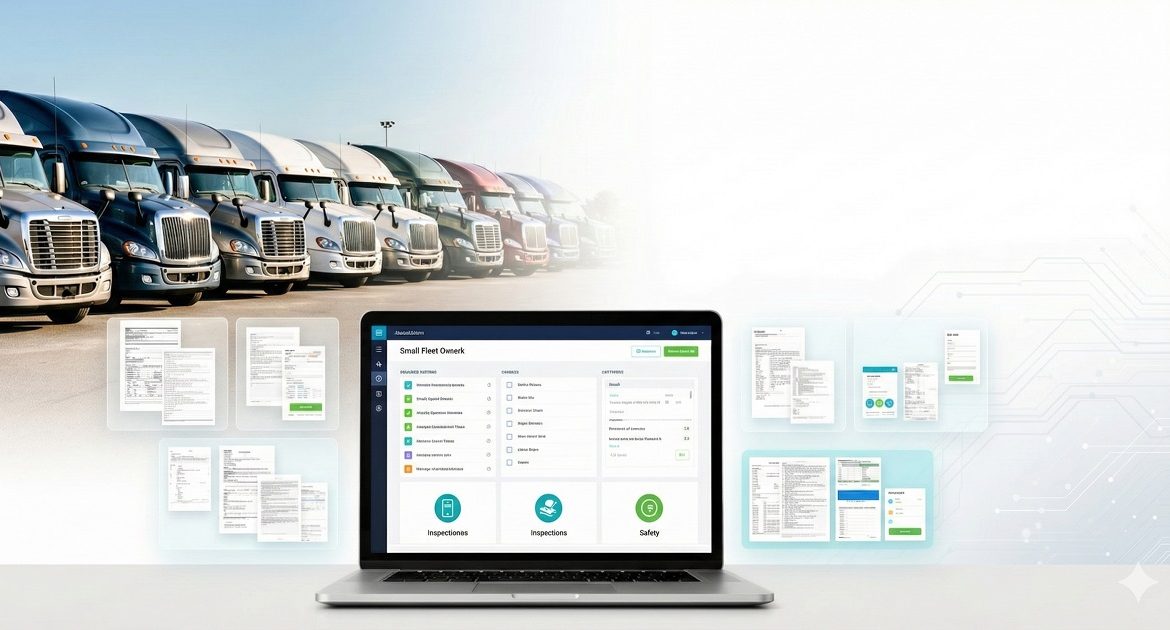
Running a small trucking fleet is a constant balancing act. You’re focused on securing loads, managing fuel costs, and keeping your trucks on the road. But looming over every mile is the Federal Motor Carrier Safety Administration (FMCSA) and its mountain of regulations. For small fleet owners, compliance isn’t just a checkbox; it’s a critical survival skill. One bad audit or a series of violations can sideline your trucks, hike your insurance premiums, and threaten your entire business.
This guide breaks down the essential components of FMCSA compliance specifically for small fleets and offers a strategic approach to managing it without sacrificing your growth.
Prefer listening?
Listen to the full podcast episode, where we dive into FMCSA compliance for small fleet owners and share practical insights from carriers who have successfully managed paperwork, avoided violations, and grown their fleets.
Get the full podcast episode to listen offline:
The Compliance Burden: It’s More Than Just Logs
Many new entrants assume compliance is just about keeping a logbook. In reality, the “Safety Department” of a trucking company—even a one-truck operation—is a complex ecosystem of ongoing responsibilities. To operate legally, you must maintain impeccable records across three main pillars:
1. Driver Compliance
Your drivers are your biggest asset and your biggest liability. FMCSA regulations require a rigorous paper trail from the moment you consider hiring someone.
Driver Qualification (DQ) Files: This isn’t a one-time file. It’s a living document containing the driver’s application, road test certificate, medical card, and annual list of violations.
Drug & Alcohol Program: You must be enrolled in a random testing consortium and conduct pre-employment queries in the FMCSA Clearinghouse.
Hours of Service (HOS): Daily monitoring of ELD logs is non-negotiable. You need to catch violations before a DOT officer does.
2. Equipment Compliance
Every vehicle in your fleet needs a paper trail as long as the road it drives on.
Maintenance Files: You must keep records of all inspections, repairs, and maintenance for every vehicle under your control.
DVIRs: Daily Vehicle Inspection Reports must be completed and retained to prove your trucks are safe to operate.
3. Corporate Compliance
This is the administrative backbone that keeps your authority active.
MCS-150 Updates: This biennial update is mandatory, even if your fleet size hasn’t changed.
UCR (Unified Carrier Registration): An annual fee based on your fleet size.
IFTA & IRP: Quarterly fuel tax filings and annual registration renewals are critical to avoiding costly fines and out-of-service orders.
The Cost of Getting It Wrong
For a small fleet, the margin for error is razor-thin. A single “Conditional” safety rating can double your insurance premiums and disqualify you from high-paying loads. An “Unsatisfactory” rating shuts you down completely.
Many owners try to handle this themselves (the “DIY Burnout” model), spending nights and weekends buried in paperwork instead of resting or planning for growth. Others hire a full-time safety manager, adding $80,000+ to their annual payroll—a crippling expense for a 5-10 truck fleet.
The Strategic Solution: Outsourcing Your Safety Department
Smart fleet owners are realizing that safety isn’t a job for the owner, nor is it affordable to hire in-house at the early stages. The modern solution is to outsource your safety department.
By partnering with a dedicated safety management firm like Synchron Safety, you transform a fixed, high-stress cost into a scalable, variable expense.
Why Outsourcing Wins for Small Fleets
Instant Expertise: You don’t just get a person; you get a team. You get an ELD expert, a tax specialist, and a claims manager all for less than the cost of one entry-level employee.
Proactive Protection: Services like our Compliance Monitor package don’t just file papers; we audit your logs daily and monitor your drivers’ license status in real-time. We catch problems before they become violations.
Scalability: When you add a truck, you don’t need to hire more office staff. Your outsourced team scales with you instantly.
- Cost Savings: For a typical 15-truck fleet, outsourcing to a service like our Proactive Safety Director package can save you over $59,000 per year compared to hiring an in-house safety director.
Take Control of Your Safety Scores
Your CSA score is your reputation in this industry. Don’t leave it to chance. Whether you choose to manage it yourself or partner with experts, the key is to be proactive. Waiting for an audit notice is not a strategy.
Ready to stop managing paperwork and start growing your fleet?
At Synchron Safety, we offer a range of packages tailored to your fleet’s size and needs, from our Authority Launchpad for new entrants to our all-inclusive Total Risk Management for established carriers.
Schedule a free 15-minute compliance review today. We’ll look at your DOT profile, identify your risks, and show you exactly how we can help you sleep better at night.